Nobody Memorizes YAML
In this article
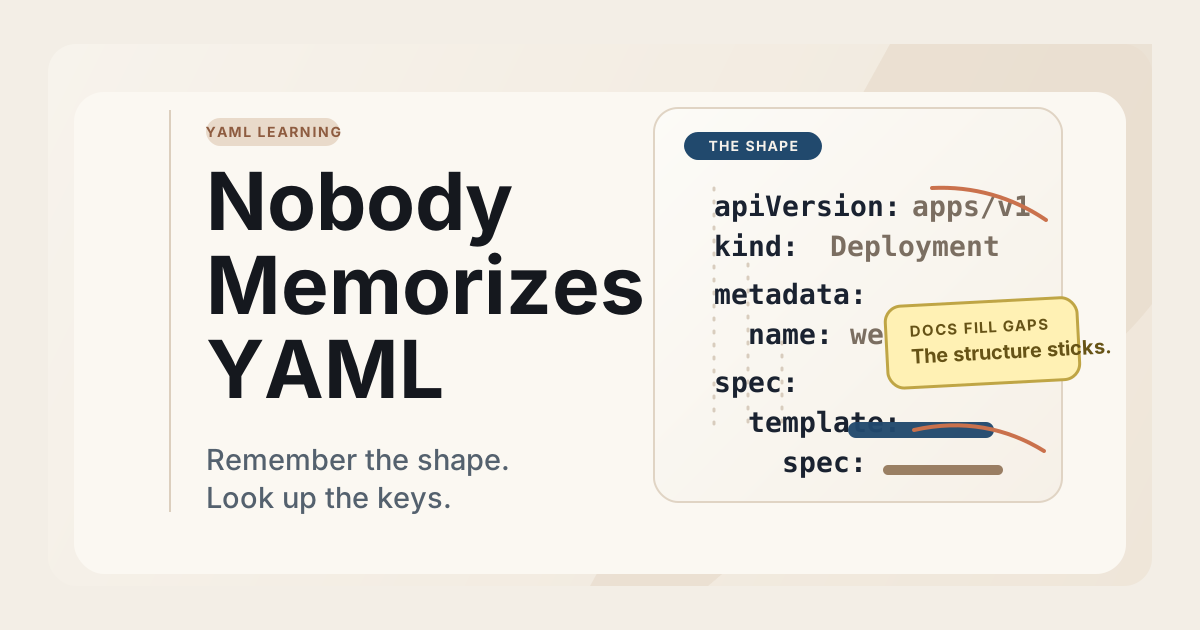
I saw a beginner ask recently whether experienced DevOps engineers actually memorize YAML. Not just the rough shape of it, but really memorize it. Full manifests. Exact field names. The whole thing.
That question took me straight back to the stage where every config file feels like a test. You open a Kubernetes manifest, forget one field name, and suddenly it feels like maybe you are behind.
From what I have seen, nobody useful is spending their time trying to memorize YAML like exam material. People remember the parts they touch every week. The rest gets looked up. That is normal.
The more interesting part is what this question is really about. It is not just YAML. It is the fear that if you still need docs, maybe you do not know the tool well enough.
What actually stays in my head
After enough repetition, some shapes stick. I can sketch a Kubernetes Deployment from memory. apiVersion, kind, metadata, spec, the nested template, the place where the containers live. Same story for a basic GitHub Actions workflow. Same story for the rough outline of an Ansible playbook.
That part is useful because it lets me read a config quickly and notice when something looks wrong. It does not mean I remember every exact field name or option. I still look up container resource syntax. I still check workflow inputs. I still forget a parameter name and open the docs.
That is not a failure of memory. It is just how the work goes. The shape lives in your head. The exact spelling lives in the docs.
The part that matters more than syntax
The teams I trust most are not the ones who type fast without looking anything up. They are the ones who understand what the config is doing.
I have spent too many hours debugging perfectly valid configuration that was still wrong for the system it was supposed to support. Valid YAML only tells you that the parser accepted it. It says nothing about whether the memory limit makes sense, whether the rollout settings are safe, or whether the health check matches how the service actually starts.
That is why I care a lot more about whether someone understands the model than whether they can write the syntax cold. If you know Kubernetes will kill a pod that pushes past its memory limit, you can make a good decision after checking the docs. If you only remember the field name, you can still make a bad call.
What repetition really does
The things you use constantly will stick on their own. No flashcards required.
I have typed ln -s more times than I can count and I still occasionally pause to make sure I have the arguments in the right order. That is a tiny command. YAML is much bigger.
The same thing happens with infrastructure config. The parts you touch every day feel automatic after a while. The parts you touch twice a year still send you back to the docs twice a year. That is fine.
One thing that helped me a lot was keeping my own reference material. Old manifests. Workflow files. Terraform modules. Ansible playbooks. When I need something similar, I start from the closest working example and adjust. Half the time I wrote the original and still need to re-read it.
The interview version of this is worse
I have heard plenty of stories about interviews that turn this into a memorization contest. No autocomplete. No docs. No copy and paste. Just write the Terraform or Kubernetes config from scratch and prove you know it.
I do not think that tells you much about how somebody will perform on the job. Real work happens with docs open, examples nearby, and a lot of verification. Nobody says, “Sorry, no references today, we are doing production from memory.”
If I am interviewing someone, I care more about whether they understand what they are trying to build, whether they know the trade-offs involved, and whether they can find the right syntax quickly without pretending. That is much closer to the real job.
The best technical interviews I have seen give people a real problem and let them use the same tools they would use at work. That usually tells you more than watching somebody perform memory tricks in a blank editor.
A lot of us learned the wrong reflex first
School trains a lot of people to think checking the book means you did not study hard enough. That habit lingers. Then you start working, reach for the docs, and some part of your brain says you should already know this.
I remember feeling that pretty hard early on. Every time I looked up a kubectl flag or re-opened the Ansible docs, it felt like evidence that I was not there yet.
No. That voice is wrong.
Reading the docs is not a sign of weakness. It is part of the job. The person who checks the docs writes the right config. The person who goes from memory writes something that is usually almost right, which in production is a very expensive category.
What I would focus on instead
If you are learning this stuff now and feeling buried in YAML, here is where I would put the effort.
Understand the model before you grind the syntax. Learn what a Deployment actually does before you try to remember every field in the manifest. Learn what a rolling update changes. Learn what causes a pod restart. Once the model makes sense, the YAML becomes much easier to navigate.
Get good at reading existing config. That matters more than people think. Most production work starts with understanding what is already there, not writing something from scratch.
Keep a personal reference. Save the working examples you trust. The people who look fast are usually not inventing everything from scratch. They have good examples and know how to adapt them.
Get comfortable with the docs. Know where the Kubernetes docs live. Use kubectl explain. Keep the GitHub Actions syntax reference nearby. Being fast at finding the answer beats pretending to have it memorized.
And let your tooling help you. Editor support, schema validation, linting, all of that saves brain space for the part that actually matters.
The real skill is different
Nobody wakes up one morning with Kubernetes, GitHub Actions, and Ansible fully memorized. The daily stuff becomes familiar. The rest lives in docs, templates, and old examples. That is not a weakness. That is just how experienced people work.
The real skill is knowing what is possible, understanding why you are doing it, and getting to the right syntax quickly when you need it.